
Ceiling Fan Direction Summer Winter: Minnesota HVAC Guide
Key Takeaways
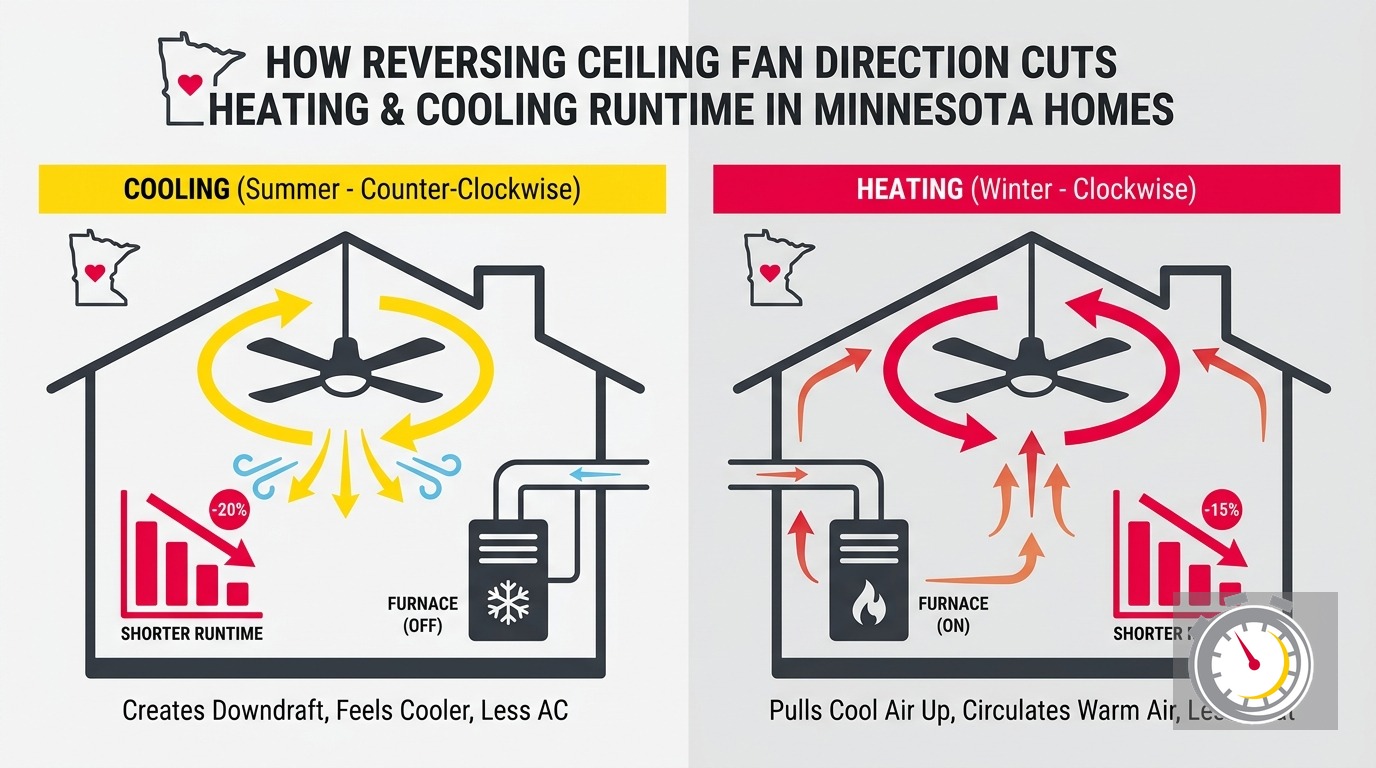
- Counterclockwise in summer: Blades moving to the left (viewed from below) create a wind-chill effect. ENERGY STAR notes this allows you to raise your thermostat up to 4°F, which can meaningfully reduce cooling energy use.
- Clockwise on low in winter: A gentle updraft redistributes warm air pooled at the ceiling. The DOE notes potential savings on heating costs in rooms with high ceilings.
- Minnesota’s 7-month heating season: The clockwise setting applies from October through April, not just a few December weeks.
- Vaulted ceilings amplify the benefit: Floor-to-ceiling temperature gaps can reach 15°F in a cathedral room. A ceiling fan on low closes that gap without another furnace cycle.
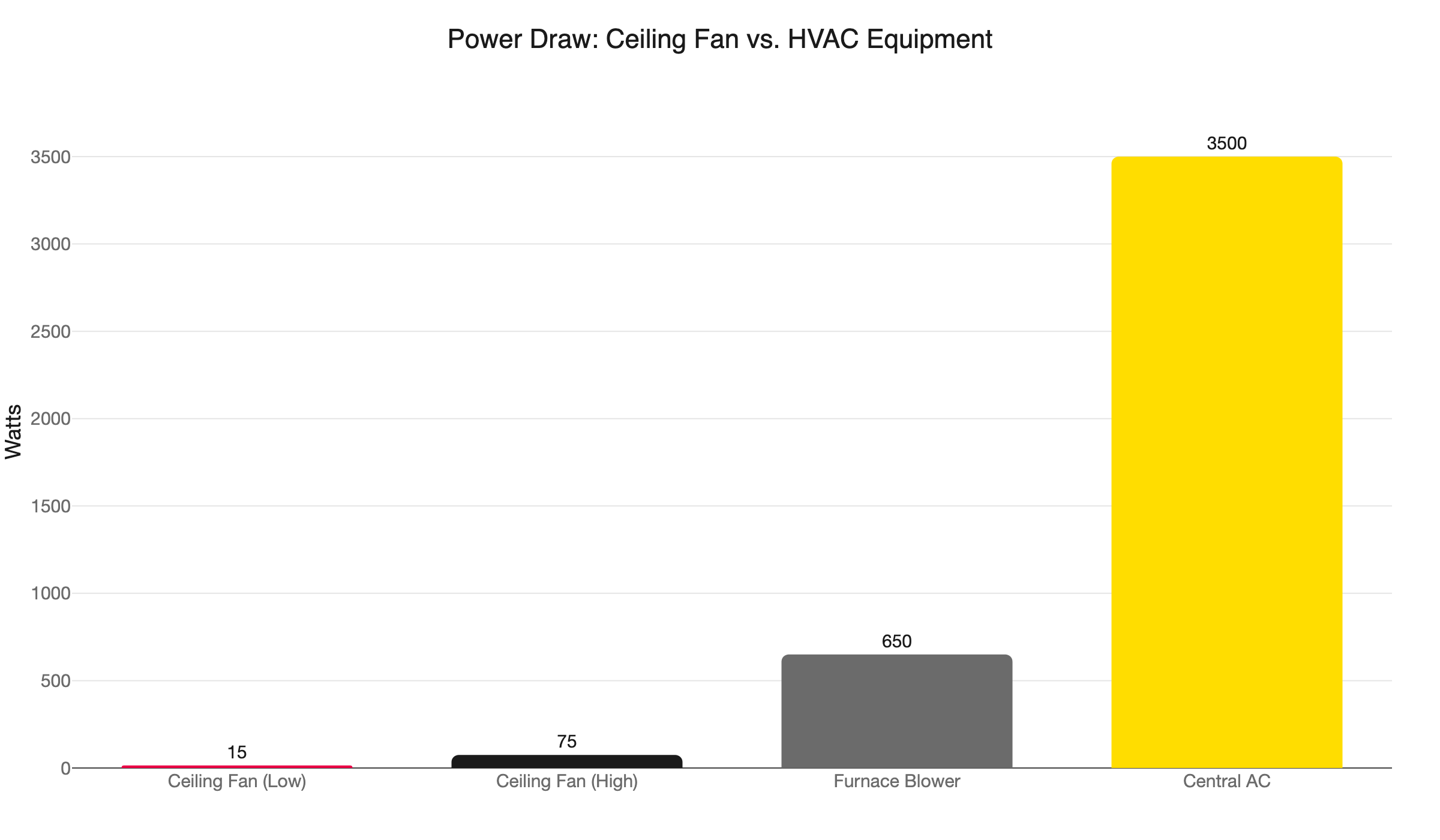
- Power draw comparison: A ceiling fan uses a fraction of the electricity of central air conditioning, with usage varying by speed. Your central AC uses 3,500 watts or more. The math on which one to run longer is clear.
- No rebates for ceiling fans: Xcel Energy does not currently offer a residential ceiling fan rebate. Pair the direction change with a smart thermostat to capture Xcel’s $50 thermostat rebate instead.
Why Does Ceiling Fan Direction Affect Your Heating and Cooling Bills?
Ceiling fan direction changes the air movement pattern in a room. In summer, counterclockwise blades push air down across occupants, creating a wind-chill effect that reduces thermostat calls. In winter, clockwise blades on low create an updraft that pulls cool air upward and returns warm ceiling air to the occupied zone, reducing how often the furnace fires.
Here is the physics in plain terms. Warm air rises and stays near the ceiling. In a standard room, this creates a temperature gradient: the ceiling is warmer than where you actually sit and move around. Your thermostat reads the temperature in the occupied zone, not at the ceiling. When the occupied zone drops below setpoint, your furnace cycles on, even if several degrees of heat are sitting unused six feet above your head.
A ceiling fan in clockwise mode on low speed creates a gentle updraft. That updraft draws cooler floor air upward. The warm ceiling air then slides outward along the ceiling and descends along the walls, back into the occupied zone. The thermostat reads a higher temperature. The furnace stays off longer.
The summer mechanism is different but equally direct. Counterclockwise rotation pushes air straight down in a column. That moving air accelerates evaporation from your skin, which is how your body sheds heat. The room temperature does not actually drop. The perceived temperature does. You feel cooler at a higher thermostat setpoint.
A ceiling fan uses a fraction of the electricity of central air conditioning, with usage varying by speed. Your central AC draws 3,500 watts or more. Your furnace blower alone draws 300 to 1,000 watts. Running a ceiling fan on low for an hour instead of triggering another furnace or AC cycle is an easy trade.
How Does Counterclockwise Direction Keep You Cooler in Summer?
Counterclockwise blades push air downward across the room, creating a wind-chill effect. ENERGY STAR reports this allows you to raise your thermostat setpoint by 4°F while maintaining the same perceived comfort. A 4°F higher setpoint means fewer thermostat calls and less AC runtime across a full cooling season.
The wind-chill effect works through evaporation. Moving air pulls heat away from your skin faster than still air does. A room at 76°F with a ceiling fan running counterclockwise can feel as comfortable as a room at 72°F with no fan movement. That 4°F gap translates directly to runtime savings. Raising your cooling setpoint by 4°F can reduce air conditioning energy use by up to 30%.
There is one rule that comes with this. Turn the ceiling fan off when you leave the room. A fan cools people, not spaces. Running it in an empty bedroom all afternoon wastes electricity without producing any benefit. The savings come from substituting fan runtime for compressor runtime when someone is actually in the room.
Minnesota’s true cooling season runs roughly May through September. That is a shorter window than our heating season, but it is when electric bills climb fastest. A 30% reduction in AC energy use during those five months is meaningful money on a summer bill.
All ENERGY STAR-certified ceiling fans include a reversible motor. If your fan does not have a direction switch, it is either very old or a non-reversible decorative model. A standard fan replacement costs less than running a fan the wrong direction for an entire cooling season.
What Does Clockwise on Low Do for Your Furnace This Winter?
Clockwise rotation on the lowest speed creates a gentle updraft. That updraft pulls cooler floor air upward and pushes warm air trapped at the ceiling outward and down the walls, back into the occupied zone. The DOE notes this can reduce heating costs, primarily in rooms with high or vaulted ceilings.
The word “low” is not optional here. Clockwise on medium or high speed creates a noticeable draft that makes a room feel colder, not warmer. You want barely perceptible air movement. The goal is to gently break up thermal stratification, not create a windchill working against you. If you can feel the fan on your skin while sitting in the room, the speed is set too high.
Timing matters too. In the Twin Cities, you do not wait until January to flip the switch. October nights regularly drop below 40°F. By mid-October, your furnace is cycling in earnest. The clockwise setting starts earning its keep then and stays relevant through late April. That is seven full months where clockwise on low is the correct call.
Forced-air gas furnaces dominate Minnesota residential heating. After a furnace cycle ends, the blower shuts off and residual warm air immediately begins to rise. A ceiling fan running clockwise on low recovers that residual heat before it pools at the ceiling. It extends each cycle’s effective warmth by several minutes before the room temperature drops enough to call for the next cycle.
Does Ceiling Fan Direction Actually Reduce Furnace Runtime?
Yes. A ceiling fan on low clockwise after your furnace shuts off continues to distribute heat already in the room. The thermostat holds its setpoint longer before calling for another cycle. Fewer cycles mean less fuel burned and less mechanical stress on furnace components over the course of a long heating season.
Here is why Minnesota homeowners get more out of this tip than most. The Twin Cities sees a high number of heating degree days each year. The U.S. national average sits around 4,500. Minneapolis logs about 84% more heating degree days than the average American city. A tip that generates modest savings in Atlanta generates proportionally larger savings here, because there are far more heating cycles in play across our longer, colder season.
Consider the compounding effect. Each 1°F reduction in your heating setpoint over an 8-hour period can lower your heating bill. A ceiling fan on clockwise low does not lower the setpoint directly. It holds the occupied zone at setpoint longer after each furnace cycle ends, which has a similar effect on total runtime. Across 7 months and roughly 8,300 heating degree days, those avoided cycles accumulate into real savings.
The other benefit is mechanical. Every furnace cycle starts with an ignition sequence. The igniter, draft inducer, and blower motor all experience wear at startup. A ceiling fan that extends the gap between cycles extends the life of those components. Fewer cycles mean fewer startups. Fewer startups mean less wear per season.
If your furnace is already struggling to keep up in extreme cold, a ceiling fan helps but cannot substitute for a properly serviced heating system. See our guide on keeping your furnace running efficiently through a Twin Cities winter for maintenance steps that address a system under stress.
Why Minnesota’s Climate Amplifies This Tip More Than Most States
Generic energy advice calibrates to national averages. National averages are not Minnesota.
The Twin Cities logs significantly more heating degree days annually than the U.S. national average. Most ceiling fan direction articles mention that the winter clockwise setting helps with heating bills. What they do not say is that the benefit scales with your heating load. In a mild climate, the heating season is short and degree-days are low. In Minneapolis, the heating season is seven months long and degree-days are nearly double the national average.
That gap means the ceiling fan direction tip is proportionally more valuable here than the same tip would be in Atlanta or Phoenix. The underlying savings mechanism is the same. But it applies to a climate that runs nearly twice the heating energy per year.
There is also a forced-air dynamic specific to Minnesota homes. After a furnace cycle ends, the blower shuts off and residual heat starts rising immediately. In a well-insulated room with 8-foot ceilings, that residual heat might stay in the occupied zone for 20 or 30 minutes. In a poorly insulated room or a high-ceiling room, it rises faster and pools near the ceiling before the thermostat can count it. A ceiling fan on low clockwise catches that heat and returns it to the occupied zone before the thermostat calls for more.
This is the real mechanism behind “ceiling fans save on heating costs.” The fan does not generate heat. It recovers heat already paid for, before the thermostat asks the furnace to make more. In a climate with 8,300 heating degree days, that recovery happens thousands of times across a season.
Natural gas furnaces dominate Minnesota residential heating. Most Twin Cities homes built in the past 50 years run a forced-air gas furnace. That specific combination, a high-cycle-count gas furnace in a stratification-prone climate, is exactly where a ceiling fan on clockwise low does its best work.
Which Rooms Benefit Most: Vaulted Ceilings and Open Stairwells
Not every room sees the same stratification. The benefit from ceiling fan direction scales with ceiling height and room geometry.
In a standard 8-to-9-foot ceiling room, the temperature difference between floor level and ceiling level runs about 8 to 12°F. That is already worth addressing. A ceiling fan on low clockwise closes a meaningful portion of that gap.
In a vaulted or cathedral ceiling room, the temperature differential can reach 15°F. Twin Cities suburban homes built between 1985 and 2005 frequently include vaulted great rooms, two-story foyers, and open stairwells. These spaces look impressive. They are also genuinely hard to heat evenly. Warm air delivered by the furnace rises directly to the peak and stays there while the occupied zone at floor level stays cool. The thermostat calls for more heat. The furnace fires. That warm air rises again.
A ceiling fan in a vaulted room running clockwise on low does substantially more work than a fan in a standard room. It is pulling a 15°F temperature differential off a high ceiling and returning that air to where people sit. When the thermostat reads a higher temperature in the occupied zone, the furnace stays off. The taller the ceiling, the more often this cycle repeats, and the more each avoided cycle saves across a heating season.
Open stairwells present a related problem. Warm air from the main level flows up the stairwell and accumulates on the upper floor, while the main level stays cool. A ceiling fan at the top of the stairwell on clockwise low can help redistribute this flow. Pairing it with the main level great room fan addresses both zones.
For a deeper look at heating and cooling challenges in these spaces, see our guide on HVAC in vaulted ceiling homes across the Twin Cities.
How Do You Switch Your Ceiling Fan Direction?
Most ceiling fans have a small slide switch on the motor housing, on the side of the fan body near the canopy. Turn the fan off, wait for the blades to stop completely, flip the switch, then turn the fan back on at low speed. Confirm the change by watching blade rotation from below.
Step by step:
- Turn the fan off at the wall switch.
- Wait for the blades to stop completely. Do not skip this step. Switching direction while the fan is still spinning can damage the motor.
- Locate the direction switch. It is a small plastic slide switch on the side of the motor housing. On most fans it is within reach from a standard step stool.
- Flip the switch to the opposite position.
- Turn the fan back on at the lowest speed setting.
- Confirm direction. Looking up at the fan from below: counterclockwise (blades moving left) for summer, clockwise (blades moving right) for winter.
Some newer ceiling fans include a remote or wall control with a dedicated direction button. Check your fan’s manual if you cannot locate the motor housing switch.
ENERGY STAR-certified fans all include a reversible motor. If your fan has no direction switch, it is likely very old or a non-reversible decorative model. A current ENERGY STAR-certified replacement is worth considering. ENERGY STAR ceiling fans are 60% more efficient than conventional fan and light units, so the upgrade pays back beyond just the direction benefit.
Should You Pair a Ceiling Fan Change with a Thermostat Adjustment?
Yes. Ceiling fan direction captures savings only when you also adjust your thermostat setpoint. In summer, raise the setpoint by 2 to 4°F when fans are running. In winter, lower it by 1 to 2°F. The fan compensates for the perceived comfort difference. Without the setpoint change, you gain comfort without reducing runtime.
The summer math is straightforward. You raise the cooling setpoint from 72°F to 76°F. The ceiling fan makes 76°F feel like 72°F through the wind-chill effect. Your AC runs less because the setpoint is higher and the thermostat calls less often. The savings appear on your electric bill.
Winter is more subtle. You drop the heating setpoint from 70°F to 68°F. The ceiling fan on clockwise low closes the floor-to-ceiling temperature gap. You still feel comfortable at 68°F because the occupied zone is no longer running 5 to 8 degrees colder than the ceiling. The furnace cycles less because it is holding a lower setpoint with less stratification working against it.
If you do not yet have a smart thermostat, this is a good time to add one. A smart thermostat can schedule setpoint adjustments automatically: raising the cooling setpoint during the hours fans typically run, dropping the heating setpoint at night when blankets take over. Xcel Energy currently offers a $50 rebate on qualifying smart thermostats. Ceiling fans are not on Xcel’s rebate list, but the thermostat that multiplies this tip is.
Our post on smart thermostats for Twin Cities homeowners covers which models qualify and how to apply for the credit. For the full picture of available HVAC rebates from both Xcel and CenterPoint, see our guide on HVAC utility rebates in Minnesota.
When to Call Northern One Hour
Ceiling fan direction is a free, five-minute adjustment. It genuinely reduces runtime when applied correctly. But if your heating or cooling system is struggling in ways that ceiling fan adjustments cannot fix, the problem is the HVAC equipment itself.
Signs you should call us:
- Your furnace runs nearly continuously but the home does not reach setpoint during cold snaps.
- Your AC runs but the house never cools below 78°F on a mild summer day.
- Your heating or cooling bill jumped 25% or more without a clear weather explanation.
- Your furnace is more than 15 years old and you are facing a repair quote over $600.
- You have persistent uneven temperatures between rooms that fan adjustments have not improved.
We are locally owned and operated in Ramsey, MN. Our team serves Minneapolis, St. Paul, Blaine, Maple Grove, Plymouth, Brooklyn Park, Woodbury, Bloomington, and the surrounding Twin Cities metro.
Our commitment to every visit is simple: “Always On Time… Or You Don’t Pay a Dime!(R).” We back every service call with transparent pricing and a 100% satisfaction guarantee. You know the cost before we start any work.
Call (763) 260-6662 or schedule online. We show up when we say we will.
Frequently Asked Questions
Should ceiling fans spin clockwise or counterclockwise in summer? +
When should I switch my ceiling fan to clockwise? +
Does ceiling fan direction reduce furnace runtime? +
Which rooms benefit most from ceiling fan direction in winter? +
Are there utility rebates for ceiling fans in Minnesota? +
Need a technician now?