
HVAC Help With Spring Allergies in the Twin Cities
Key Takeaways
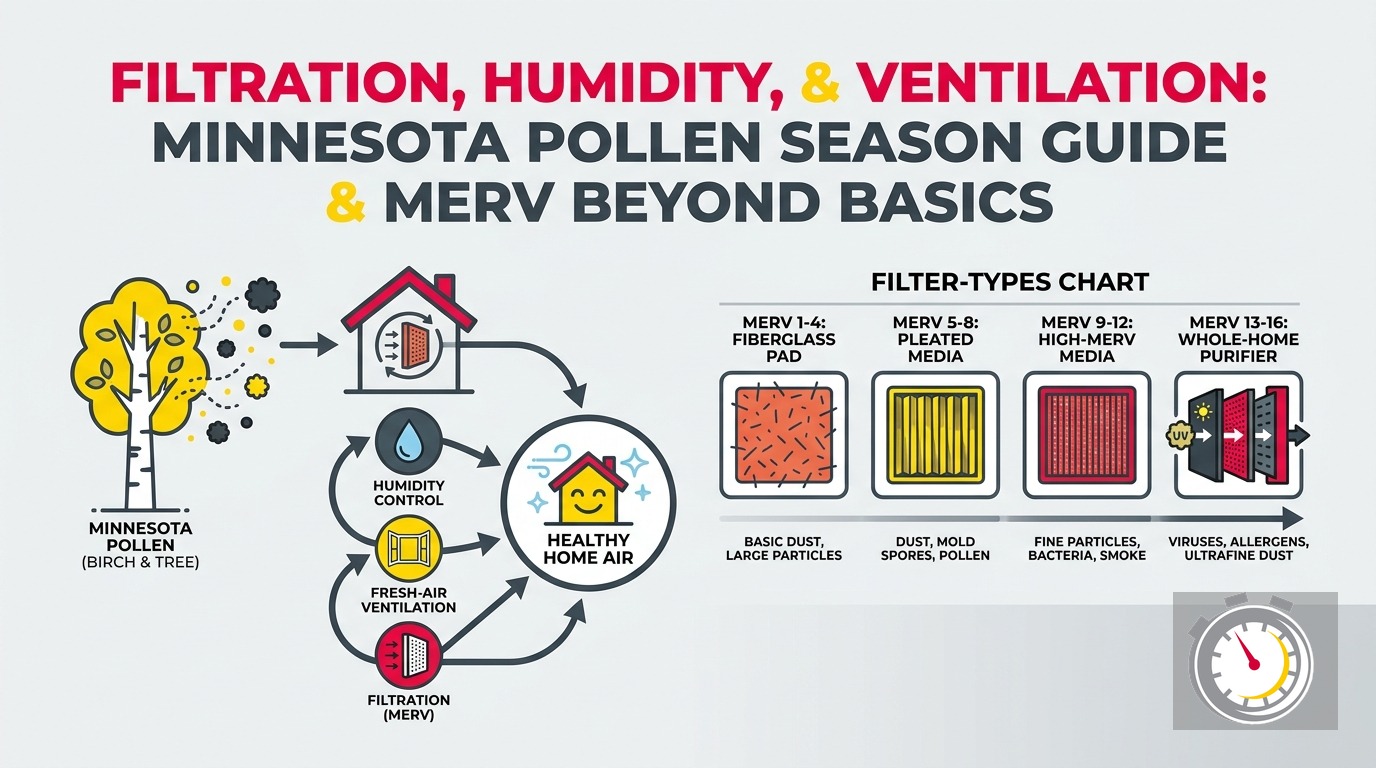
- Minnesota’s tree pollen season peaks April through late May. Birch, oak, juniper/cedar, and mulberry are the primary offenders in the Twin Cities metro.
- MERV 13 is the EPA’s recommended standard for residential indoor air quality. MERV 11 is the next-best option if your system can’t handle the added pressure drop.
- The meaningful filtration upgrade for allergy sufferers happens at 1-3 microns, where pollen fragments and fine mold spores live. MERV 11 captures 65% of particles at that range; MERV 13 captures 85% or more.
- Opening windows in April floods your home with pollen at peak season. An energy recovery ventilator (ERV) delivers fresh filtered air without that cost.
- Minnesota homes run very dry in winter. By mid-April, a whole-house humidifier still on its winter setting can push indoor humidity past 50%, encouraging mold and dust mites.
- Your ERV has its own intake filter, separate from your furnace filter. Inspect it monthly from April through June.
HVAC Help With Spring Allergies in the Twin Cities
Minnesota’s allergy season is now 27 days longer than it was in the 1970s. For Twin Cities homeowners, that means more weeks of birch, oak, and tree pollen in the outdoor air. If you’re looking for HVAC help with spring allergies in the Twin Cities, one fix won’t be enough. Filtration, humidity control, and fresh-air ventilation all interact. Address only one and the others can work against you.
This post explains how the three systems stack together, what the research actually says about MERV ratings, and why your ERV’s intake filter may matter just as much as your furnace filter during pollen season.
Why Does Minnesota’s Pollen Season Hit So Hard?
The short answer: Minnesota springs arrive late but intensify quickly. Birch and oak pollen release is compressed into April and May, which happens to coincide with the most inviting outdoor weather of the year. Climate change has pushed the season’s start earlier, adding weeks to the exposure window on both ends.
The Twin Cities’ dominant tree pollens are oak, birch, juniper/cedar, and mulberry. Season runs from early April through late May for most of them. Pollen from Minneapolis monitoring stations can travel 100 to 150 miles, which means your neighborhood’s tree mix offers limited protection from regional pollen loads.
The season has grown measurably harder. Minnesota’s allergy season is now 27 days longer than it was in the 1970s, driven by warming temperatures that push the spring bloom earlier. Elevated pollen days in Minneapolis have trended upward over the long-term monitoring record.
The health stakes are real. About 1 in 13 Minnesota adults has asthma, and pollen is a direct trigger for allergy-driven attacks. Twin Cities allergists have seen more patients arriving on maximum doses of antihistamines and nasal steroids without adequate relief.
Pollen is not just an outdoor nuisance. It enters homes through open doors, gaps around windows, and on clothing. Once inside, particles settle on surfaces and re-enter the air every time something disturbs them. Indoor air should be a refuge from the outdoor load. Your HVAC system is what makes it one.
What Do MERV Ratings Actually Filter?
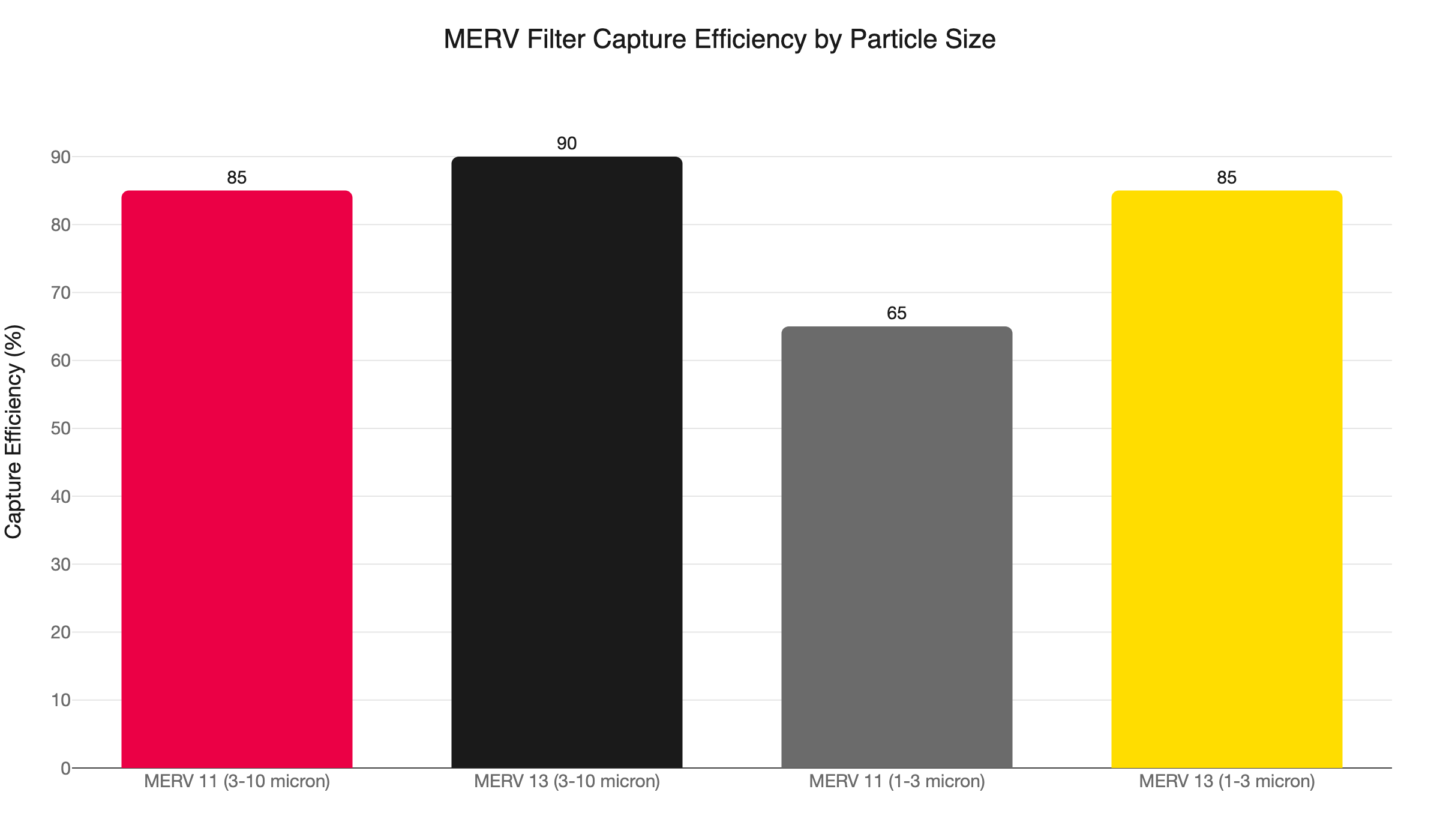
The short answer: MERV ratings describe a filter’s capture efficiency across three particle size ranges. For allergy sufferers, the critical range is 1 to 3 microns, where pollen fragments and fine mold spores live. MERV 11 captures 65% of particles in that range; MERV 13 captures 85% or more. That gap matters most if you have severe allergies or asthma.
Most filter guides stop at “higher is better.” The physics matter more than the number.
Birch pollen whole grains measure 10 to 40 microns. Even a MERV 8 filter catches most of those. The real problem is pollen fragments, which break off the grain and measure under 3 microns. Those fragments are small enough to reach the lower airways and trigger more severe inflammatory responses.
EPA indoor particulate matter data breaks the comparison down clearly:
- At 3 to 10 microns (whole pollen grains), MERV 11 captures 85%+ and MERV 13 captures 90%+. The gap is small.
- At 1 to 3 microns (pollen fragments, fine mold spores), MERV 11 captures 65% and MERV 13 captures 85%+. That 20-point difference is where the meaningful upgrade lives for severe allergy and asthma sufferers.
The EPA recommends MERV 13, or “as high a rating as your system fan and filter slot can accommodate,” for residential IAQ. Running your furnace fan continuously with a MERV 13 filter can reduce indoor fine particle concentrations by roughly 50%. Even a lower-efficiency filter run continuously reduces particles by about 24%, per the same EPA data.
That last point matters: continuous fan operation multiplies the benefit of any filter. Most thermostats let you set the fan to “on” rather than “auto.” During peak pollen weeks in April and May, consider switching to continuous mode.
One caution before you upgrade: check with a technician first. Some older or smaller air handlers can’t push enough airflow through a denser filter. That restriction strains the blower motor and can reduce system efficiency. If your system isn’t rated for MERV 13, MERV 11 is a genuine improvement that usually fits without airflow issues.
For a deeper look at filter types and supplemental air purification, our guide to air purifiers vs. filters and MERV ratings covers the tradeoffs in full.
Also: change your filter more often in spring. April through June, a monthly swap is appropriate for most homes. Filters load faster when pollen counts are high, and a loaded filter cuts both air passes and capture efficiency.
Should You Open Your Windows in April?
The short answer: No. The Twin Cities’ most pleasant spring weeks coincide exactly with peak birch and oak pollen release. Opening windows in April or May floods your home with the particles your filtration system is designed to remove. A MERV 13 filter on your furnace does nothing for pollen that enters through an open window instead of the air handler.
The window-opening trap is understandable. After months of sealed, heated air, the first 55-degree evening feels like relief. The instinct to let fresh air in is natural and reasonable.
The problem is timing. Minnesota’s tree allergy season starts late March to early April and peaks through May. Birch and oak follow maple and elm, reaching maximum pollen counts during exactly the weeks when open windows feel most welcome.
When you open a window during a high-pollen day, airborne particles settle on furniture, floors, and bedding. They bypass your HVAC system entirely. The pollen load inside your home climbs regardless of what your furnace filter is doing.
The answer is mechanical fresh-air ventilation, not an open window. That is what an ERV provides.
What Is an ERV, and Do You Need One?
The short answer: An ERV brings continuous fresh outdoor air into your home while exhausting stale indoor air. It recovers 70 to 80% of the heat energy in the outgoing air, so ventilation doesn’t spike your heating bill. The incoming air passes through a dedicated filter before it enters your living space, blocking pollen without the trade-off that comes with open windows.
Minnesota’s newer homes are built tight. Insulation and air-sealing requirements have increased significantly over the past two decades. A well-sealed home doesn’t exchange air naturally the way older, leakier homes do. That is good for energy efficiency and a challenge for indoor air quality. Without mechanical ventilation, stale air, CO2, and indoor pollutants concentrate.
An ERV addresses this directly. It works as a controlled lung for your home: fresh filtered air in, stale air out, with a heat exchanger core that recovers warmth from the exhaust stream and transfers it to the incoming air. Department of Energy data shows ERVs recover 70 to 80% of the heat energy in outgoing air, making continuous ventilation practical even through Minnesota winters.
Here is the part most homeowners miss: the ERV has its own dedicated intake filter, separate from your main furnace filter. DOE Building America guidance specifies that fresh-air intakes on balanced ERV/HRV systems must be filtered at MERV 11 or higher. That intake filter has its own maintenance schedule and is routinely overlooked.
During high-pollen periods, the ERV’s intake filter can load faster than your furnace filter. In the Twin Cities from April through June, inspect the ERV intake filter monthly. A clogged intake filter cuts fresh-air delivery and can create slight negative pressure that pulls unfiltered air in through gaps around seals.
If you don’t have an ERV and your home was built after roughly 2000, a ventilation assessment is worth scheduling. Our guide to HRV and whole-home ventilation in Minnesota explains the differences between HRV and ERV units and which situations favor each.
How Does Indoor Humidity Affect Spring Allergies?
The short answer: Below 30% relative humidity, airways dry out and allergy symptoms worsen. Above 50%, mold and dust mites thrive and add their own allergens to your indoor air alongside pollen. The EPA target is 30 to 50% RH. In Minnesota, hitting that range requires active seasonal adjustment, not a set-and-forget humidistat.
The humidity paradox in Minnesota homes plays out every spring.
Forced-air heating dries indoor air significantly. By February, many Twin Cities homes sit at 20 to 30% relative humidity. Static electricity increases, skin gets dry, and airways dry out. Many homeowners respond by installing a whole-house humidifier. That is the right call for winter comfort.
Spring changes the equation. Outdoor humidity starts rising in late March and climbs steadily through May. If a whole-house humidifier is still running at its winter setting, indoor RH can exceed 50% by mid-April.
The EPA recommends keeping indoor humidity below 60%, ideally between 30% and 50%, to prevent mold growth. At or above 50% RH, dust mites also thrive. Both mold spores and dust mite particles are year-round indoor allergens that recirculate on every air pass through your system.
Here is the compounding scenario: your home reaches peak pollen season while the humidifier is still running at winter output. Indoor RH exceeds 50%. Mold spores and dust mite particles join the pollen in your indoor air. Your MERV 13 filter is working against all three simultaneously, but continuous indoor allergen generation is harder to manage than outdoor pollen that enters through gaps alone.
The fix requires attention, not new equipment. Check your humidistat in April. As outdoor temperatures and humidity rise, reduce the humidifier’s output or shut it off entirely until fall. A smart thermostat with a humidity sensor can automate this. Set a target of 40 to 45% RH and check the reading weekly through spring.
If your home tends toward high indoor humidity even without a humidifier running, our post on whole-home dehumidifiers in the Twin Cities explains when dehumidification makes sense and what sizing looks like.
How the Three Systems Work Together
Filtration, humidity control, and fresh-air ventilation are usually presented as three separate tips. They work as a system, and each affects how well the others perform.
Your furnace filter captures airborne particles on every pass through the air handler. The filter’s capture rate assumes air is moving through it. Running the fan continuously increases the number of passes per hour. A MERV 13 filter running continuously removes significantly more total particles than the same filter running only when heating or cooling is called for.
Your ERV delivers continuous filtered fresh air. Without it, your options in April are open windows or sealed indoor air. Open windows bypass your filtration system entirely. Sealed indoor air accumulates CO2 and indoor pollutants. The ERV is the third option: outdoor air filtered at the intake, pre-conditioned through the heat exchanger core, delivered continuously to your living space.
Your humidity control prevents secondary allergen generation. Even if your MERV 13 filter catches 85% of pollen fragments on each pass, mold spores and dust mite particles from a humid indoor environment recirculate on every subsequent pass. Managing humidity removes the source rather than endlessly filtering the output.
When one part of the stack fails, it degrades the others. A clogged ERV intake filter means reduced fresh-air delivery and possible unfiltered infiltration around seals. A humidifier running past its season means continuous mold spore generation that your filter has to work against. A furnace fan running on “auto” means fewer total air passes and a lower effective capture rate regardless of filter rating.
The EPA’s framework for indoor air quality identifies three core levers: source control, ventilation, and filtration. People spend roughly 90% of their time indoors, and indoor pollutant concentrations are often several times higher than outdoors. All three levers working together outperform any single one pulled hard.
Getting HVAC Help With Spring Allergies in the Twin Cities
If your allergy symptoms are significantly worse indoors than outdoors during spring, or if you or your family has asthma and notices more attacks in April and May, your home’s IAQ stack may need attention.
Here are the specific signs it’s time to call a pro:
- You don’t know what MERV rating your current furnace filter is
- Your filter is MERV 8 or lower and hasn’t been upgraded
- Your home was built after 2000 but doesn’t have an ERV or HRV
- Your whole-house humidifier has been running since October with no seasonal adjustment
- You don’t know where your ERV’s intake filter is or when it was last replaced
- Your furnace fan runs on “auto” and you haven’t tried continuous mode during pollen season
Our indoor air quality services include filtration assessment, humidifier and dehumidifier service, and ERV/HRV inspection and installation. We’re locally owned and operated in Ramsey, and we serve the Twin Cities metro: Minneapolis, St. Paul, Blaine, Maple Grove, Plymouth, Brooklyn Park, Woodbury, and Bloomington.
We work on the on-time promise: “Always On Time… Or You Don’t Pay a Dime!(R).” You get a confirmed arrival window, not a four-hour wait. Our technicians know how Minnesota’s spring season affects your home’s air.
Call (763) 260-6662 or book online to schedule your IAQ assessment before pollen season peaks.
Frequently Asked Questions
What MERV rating filter should I use for spring allergies? +
Should I open my windows in spring if I have allergies? +
What is an ERV and how does it help with spring allergies? +
What indoor humidity level should I target during allergy season? +
Need a technician now?