
HVAC Financing Twin Cities: Your Complete 2026 Guide
Key Takeaways
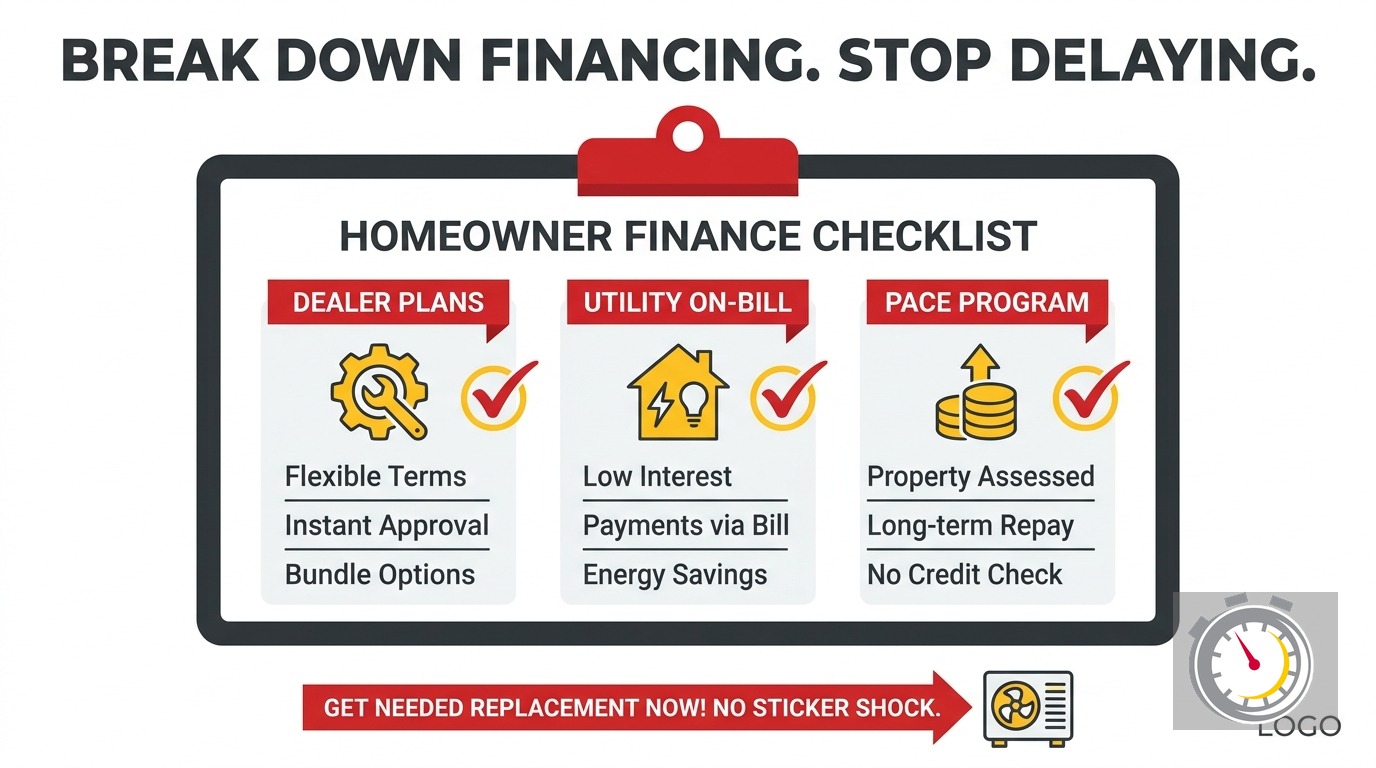
- HVAC financing in the Twin Cities breaks into four tracks: dealer plans, utility on-bill programs, rebates, and federal tax credits. Most homeowners can stack two or three on a single install.
- The biggest trap with dealer 0% financing is deferred interest. If you don’t pay the full balance before the promo period ends, retroactive interest is calculated on your original balance at rates often running 26-29%.
- PACE financing is not available for single-family homes in Minnesota. It covers commercial, nonprofit, and multifamily properties (5+ units) only.
- CenterPoint Gas customers can get up to $1,000 for a 97%+ AFUE furnace installed by December 31, 2026.
- Xcel Electric customers can get up to $2,000 for a qualifying cold-climate heat pump.
- The IRS Section 25C credit returns 30% of cost at tax time - up to $2,000 for a heat pump or $600 for a qualifying furnace or central AC.
- Income-qualified Minnesota households may qualify for up to 100% of project cost through the state HEAR program.
- A household with CenterPoint gas and Xcel electric can stack rebates from both utilities on the same project.
What HVAC Financing Options Are Available in the Twin Cities?
The short answer: Four main tracks cover most homeowners - dealer or contractor financing plans, utility on-bill programs through CenterPoint or Xcel Energy, government and utility rebates that cut the upfront cost, and federal tax credits that return money at tax time. Each has different eligibility rules and mechanics.
The right combination depends on your gas and electric utilities, your income, the equipment you choose, and your timeline. A homeowner whose furnace failed last night has different priorities than one planning a proactive upgrade this fall.
Here is how each track works.
What Is the Deferred-Interest Trap on 0% HVAC Financing?
The short answer: “0% for 12 months” dealer financing is almost always deferred interest, not true zero-interest financing. If you don’t pay the full balance before the promo end date, retroactive interest - often 26-29% - is calculated on your original balance and added back. That can cost thousands more than expected.
Here is the mechanic. Say you finance a $6,000 furnace on an 18-month 0% promo plan. You pay $250 per month and owe $1,500 when month 18 ends. The lender does not charge 27% on the $1,500 remaining balance. It charges 27% on the original $6,000 - for the full 18 months, retroactively. Your remaining balance can jump by more than $2,400 in one statement.
True zero-interest financing exists but is uncommon. It is usually reserved for a lender’s top credit tier. Most “0% APR” offers at point of sale are deferred interest in disguise.
Before you sign any dealer financing agreement:
- Ask directly: “Is this deferred interest or true zero-percent APR?”
- Look for the phrases “deferred interest” or “retroactive interest” in the contract.
- Set autopay to clear the balance before the promo expiration date - ahead of it, not on the last day.
- If only deferred-interest plans are available, confirm the payoff timeline is realistic for your budget before signing.
Dealer financing can still be the right call. The interest-free window is genuinely useful when you pay on schedule. The trap only closes on homeowners who didn’t know it was there.
Can You Finance Your HVAC Through Your Utility Bill?
The short answer: Yes, if CenterPoint Energy is your natural gas utility. CenterPoint offers two on-bill programs - Home Service Plus (HSP) financing and the EZPAY On-Bill Loan - that add repayment directly to your monthly gas bill. No separate lender, no second payment to track.
CenterPoint HSP Financing
Home Service Plus financing offers no finance charges for short terms of 1, 3, or 12 months. Longer terms extend to 120 months. Payments appear on your regular CenterPoint statement alongside your monthly gas charges.
This is a practical option if you want one bill to manage. A 120-month term spreads a large install over 10 years. That is useful for homeowners who need breathing room but want to avoid the uncertainty of deferred-interest dealer plans.
CenterPoint EZPAY On-Bill Loan
EZPAY is a separate product listed under CenterPoint’s efficiency programs. It is designed with lower credit thresholds than traditional loans. That makes it accessible for customers who may not qualify for prime dealer financing. Full terms require contacting CenterPoint directly or logging into your account, as they are not posted publicly.
Both on-bill products are available to residential customers with an active CenterPoint natural gas account.
Minneapolis On-Bill Pilot: Watch This Space
The City of Minneapolis has sought regulatory approval for a Pay As You Save on-bill program through CenterPoint’s rate case. The proposed $50 million pilot would serve roughly 10,000 households. It would carry no credit check and no income requirement. The repayment obligation would transfer with the property on sale.
As of this writing, the program is pending regulatory approval. Confirm current status with the City of Minneapolis or CenterPoint before planning around it.
What HVAC Rebates Are Available Right Now in Minnesota?
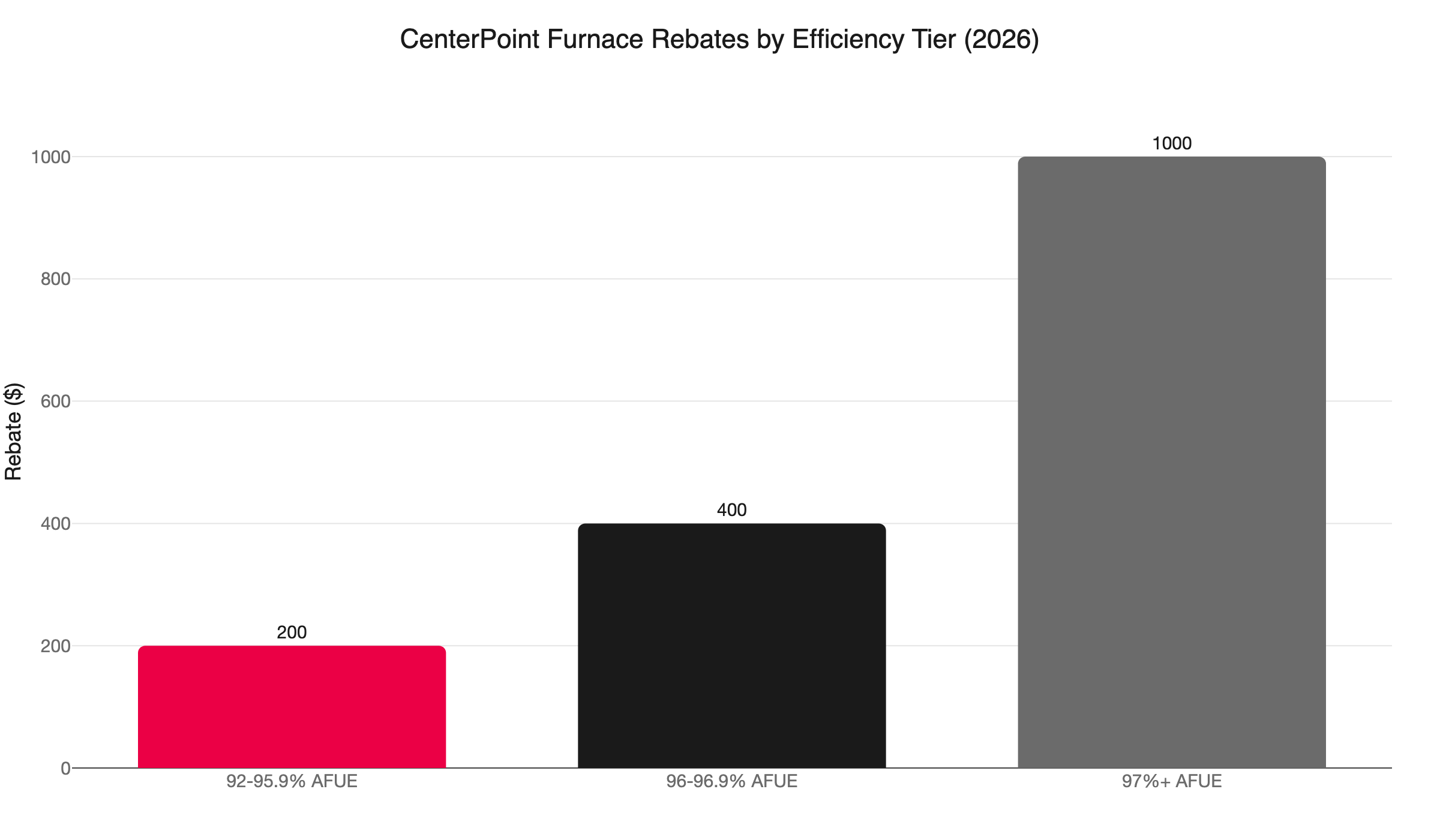
The short answer: CenterPoint Gas customers can get up to $1,000 for a 97%+ AFUE furnace installed by December 31, 2026. Xcel Electric customers can get up to $2,000 for a qualifying cold-climate heat pump. Both reduce your cost before you finance anything.
CenterPoint Heating Rebates (Natural Gas Customers, 2026)
For equipment installed by December 31, 2026:
- 97%+ AFUE furnace replacement: $1,000
- 96-96.9% AFUE furnace replacement: $400
- 92-95.9% AFUE furnace replacement: $200
- Condensing boiler at 91%+ AFUE: $500
- Standard boiler at 85%+ AFUE: $300
One detail worth flagging: Minnesota’s energy code requires a 92% AFUE minimum for gas furnaces. Every qualifying replacement in this state is already a high-efficiency unit. Many contractors default to 96% equipment. Moving up to 97%+ costs more upfront, but the jump from a $400 rebate to a $1,000 rebate often offsets that difference. Ask your contractor to quote both efficiency tiers before you decide.
Xcel Energy HVAC Rebates (Electric Customers, 2026)
For Xcel electric customers:
- Cold-climate air-source heat pump: up to $2,000, or up to $2,600 with an insulation and air-sealing bonus
- High-efficiency gas furnace replacement: up to $500
- Smart thermostat (Nest, Ecobee, and similar): $50-$75
The heat pump eligibility requirement matters in this climate. The unit must have a coefficient of performance (COP) of at least 1.75 at 5 degrees Fahrenheit. It also must appear on the Northeast Energy Efficiency Partnerships list at ashp.neep.org.
This is not a technicality. Minnesota winters regularly hit 5°F and lower. A heat pump that can’t hold that efficiency level in a Minneapolis winter is undersized for the job. Confirm the specific model and configuration meets the 5°F COP threshold before assuming the Xcel rebate applies.
Applications for 2025 installs are accepted through September 30, 2026.
Stacking Rebates from Both Utilities
Many Twin Cities homes use CenterPoint for natural gas and Xcel for electricity. That combination unlocks rebates from both programs on a single project.
Example: you replace a gas furnace (CenterPoint: up to $1,000) and add a smart thermostat (Xcel: up to $75) in the same appointment. You receive rebates from two different sources for one service call. Stack the IRS tax credit on top and the amount you need to finance drops significantly.
For a deeper look at the heat pump rebate landscape, see our post on Minnesota heat pump rebates and tax credits.
Does PACE Financing Work for Twin Cities Homeowners?
The short answer: No. Minnesota’s active PACE programs cover commercial, nonprofit, and multifamily properties with five or more units only. Residential PACE for single-family homes is not available in Minnesota.
This matters because national HVAC content frequently lists PACE as a homeowner financing option without flagging state restrictions. In Minnesota, that information does not apply to single-family homes.
PACE stands for Property Assessed Clean Energy. The concept: a lender finances an energy improvement. Repayment is structured as a special property tax assessment. The obligation can transfer with the property when it is sold.
That sounds appealing in theory. In practice, Minnesota’s active program - MinnPACE, administered through the Saint Paul Port Authority - serves commercial and multifamily properties only. Ramsey County’s PACE program is also non-residential, with terms up to 30 years and loan-to-value limits of 30%.
The Minnesota Legislature established a Residential PACE Consumer Protection Task Force to study the foreclosure and lien risks R-PACE poses for single-family homeowners. Minnesota has not moved forward with residential PACE since.
If a contractor or lender offers you PACE financing on a Twin Cities home, ask for the specific program name. Verify eligibility before signing anything.
What Federal Tax Credits Apply to HVAC Replacements?
The short answer: The IRS Section 25C Energy Efficient Home Improvement Credit returns 30% of your installation cost at tax time. The annual cap is $2,000 for a qualifying heat pump or $600 for a qualifying furnace or central AC. You claim it on your federal return for the year of installation.
IRS 25C: What Qualifies
- Air-source heat pumps: 30% of cost, $2,000 annual cap; equipment must meet the CEE highest efficiency tier
- Qualifying furnaces and central AC units: 30% of cost, $600 cap per item
- Electrical panel upgrades to support HVAC (200-amp or above, meeting NEC code): up to $600
The credit applies per tax year, and you can claim it year after year on different improvements. Replace your furnace in 2026 and add a heat pump in 2027. You can claim $600 for this year and $2,000 for next year - two separate credits, two tax returns.
Minnesota State Rebates: HEAR and HOMES
Minnesota administers two additional programs funded through federal Inflation Reduction Act dollars:
HEAR (Home Electrification and Appliance Rebates): Point-of-sale rebates for income-qualified households.
- Under 80% of area median income: up to 100% of project cost
- 80-150% of area median income: up to 50% of project cost
These reduce the purchase price at the point of sale. They are not a credit you wait for at year-end - the cost comes down before you pay or finance anything.
HOMES Rebate: $2,000 to $8,000 for whole-home upgrades that cut energy use by 20-35% or more.
Residential Heat Pump Rebate: Up to $4,000 for qualifying air-source heat pump installs.
Funding runs through 2031 but is first-come, first-served. Verify current availability with the Minnesota Department of Commerce before planning a project around these programs.
The combined rebate and tax credit ceiling for a heat pump is substantially higher than for a furnace upgrade. See our full breakdown on whether heat pumps are a good fit for Minnesota homes before deciding between the two paths.
Which Financing Track Fits Your Situation?
The short answer: The right track depends on your timeline, utilities, and income. Emergency replacements point toward dealer financing or CenterPoint on-bill programs. Planned upgrades benefit from stacking rebates first. Income-qualified households should start with the HEAR program before looking at any financing.
Here is a simple decision framework:
Your system failed suddenly and you need to act fast. Dealer financing is the most common path. Ask whether the plan is deferred interest or true 0% APR. If only deferred-interest is available, build a clear payoff schedule before signing. CenterPoint’s on-bill programs are a parallel option for gas customers.
You have time to plan. Stack rebates first. Apply for CenterPoint and Xcel rebates upfront, time your install around the tax year for the 25C credit, and check HEAR eligibility before the appointment. Reducing the financed balance first improves every other financing option.
You want the lowest monthly payment over the long term. CenterPoint’s HSP and EZPAY programs extend to 120 months. Credit thresholds are lower than most dealer plans, and payments roll into your utility bill.
You are income-qualified. Start with the HEAR program. Getting 50-100% of project cost covered at the point of sale changes the entire math on what you need to finance.
You are weighing a furnace against a heat pump. The combined ceiling from Xcel rebates, the 25C credit, and potential HEAR rebates for a heat pump can be substantially higher. Run the rebate math on both paths before deciding. For a cost reference on the furnace side, see our post on furnace replacement costs in the Twin Cities.
Questions to Ask Before You Sign Any Financing Agreement
Whether you are looking at a dealer plan or a utility on-bill program, get clear answers to these before committing:
- Is this deferred interest or true zero-percent APR? What happens to my balance if I don’t pay in full by the promo end date?
- What is the interest rate after the promotional period?
- Are there origination fees, prepayment penalties, or annual charges?
- Which rebates are already applied to this quote, and which ones do I need to apply for separately?
- Does the equipment qualify for CenterPoint or Xcel rebates? Does the furnace hit 97%+ AFUE for the full CenterPoint rebate?
- Will you provide documentation I can use for my Section 25C tax credit claim?
A contractor who answers these questions directly and puts rebate eligibility in writing is one you can trust. If a quote bundles equipment and financing in a way that obscures either number, ask for them itemized. Commit once you can see both clearly.
See our post on what to expect on HVAC install day in the Twin Cities for a full picture of the process from estimate to system startup.
Ready to Move Forward? We’re Here.
HVAC financing in the Twin Cities doesn’t have to mean sticker shock. Utility rebates reduce the amount you finance before you sign anything. Federal tax credits recover more at year-end. On-bill programs keep payments simple. Dealer financing bridges the gap when timing is tight. Most homeowners have more options than they realize - the key is knowing which ones apply before the estimate arrives.
We are a locally owned and operated HVAC company serving Minneapolis, St. Paul, Ramsey, Blaine, Maple Grove, Plymouth, and the surrounding communities. When you call us, we show up when we said we would. That is the promise behind “Always On Time… Or You Don’t Pay a Dime!(R)” - backed by a 100% satisfaction guarantee and honest, transparent pricing.
Call us at (763) 260-6662 or book online. Our team will walk you through which rebates apply to your system, what financing options make sense for your situation, and what the job will cost before you commit to anything.
Frequently Asked Questions
What is the deferred-interest trap in HVAC financing? +
Is PACE financing available for Twin Cities homeowners? +
Can I stack CenterPoint and Xcel rebates on the same HVAC project? +
What is the IRS Section 25C credit for HVAC? +
Need a technician now?