
Furnace Replacement Cost Twin Cities: What to Budget in 2026
Key Takeaways
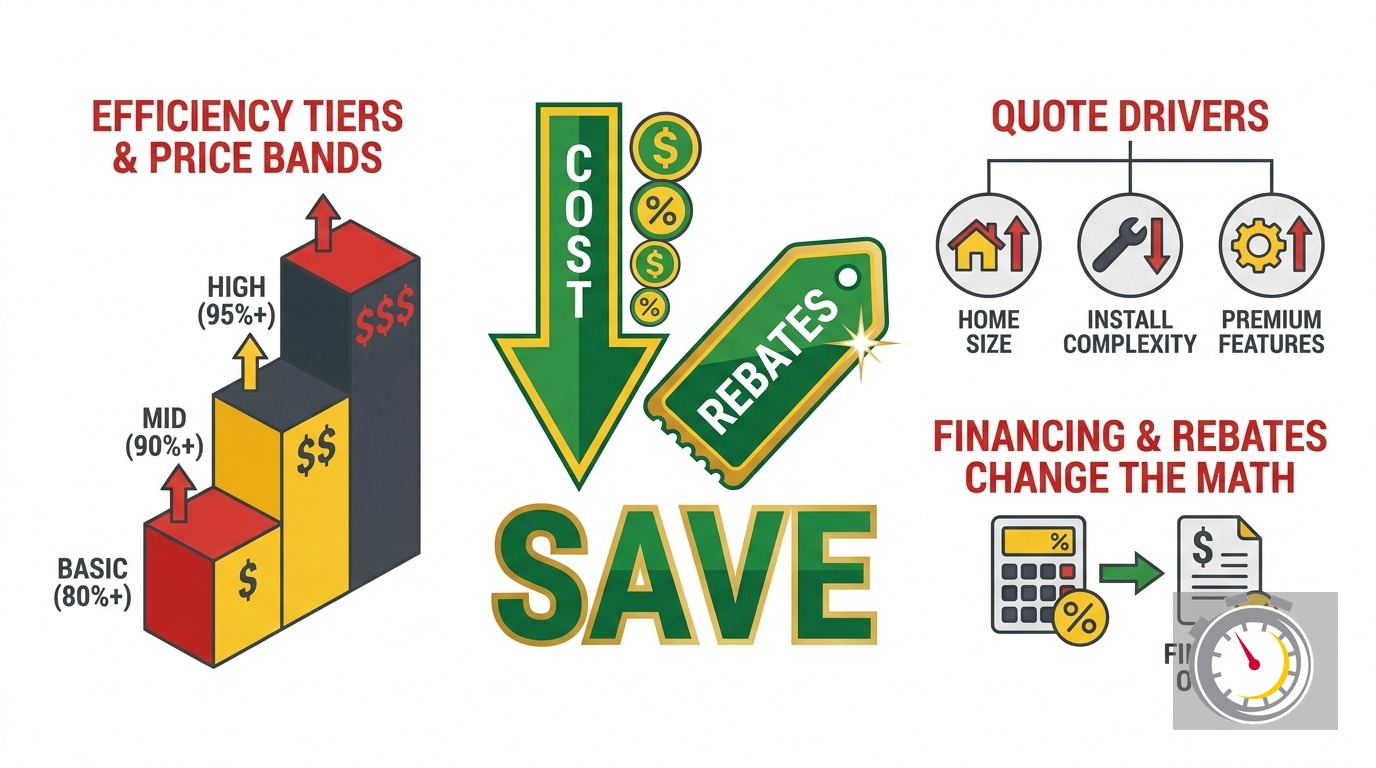
- Most Twin Cities homeowners pay $5,000-$7,500 installed for a 95-96% AFUE two-stage condensing furnace, the most common replacement tier.
- The federal Section 25C tax credit was eliminated effective December 31, 2025. Any source still showing a “federal rebate” or “up to $600 credit” is citing expired law.
- Minnesota’s energy code requires 90%+ AFUE for most furnace replacements. Many Twin Cities homeowners cannot legally install a new 80% unit to replace an existing one.
- Xcel Energy and CenterPoint Energy rebates of $200-$400 each still apply for qualifying 95%+ AFUE furnaces in 2026.
- Income-qualified CenterPoint customers may receive up to $1,200 in rebates. Few competitors mention this tier.
- Every furnace replacement in Minnesota requires a mechanical permit. Budget $150-$450 and verify your contractor’s DLI license before signing.
- Upgrading from a mid-efficiency unit to a 95-96% AFUE furnace can save roughly $300-$600 per year on gas bills in Minnesota’s climate.
What Does Furnace Replacement Cost in the Twin Cities?
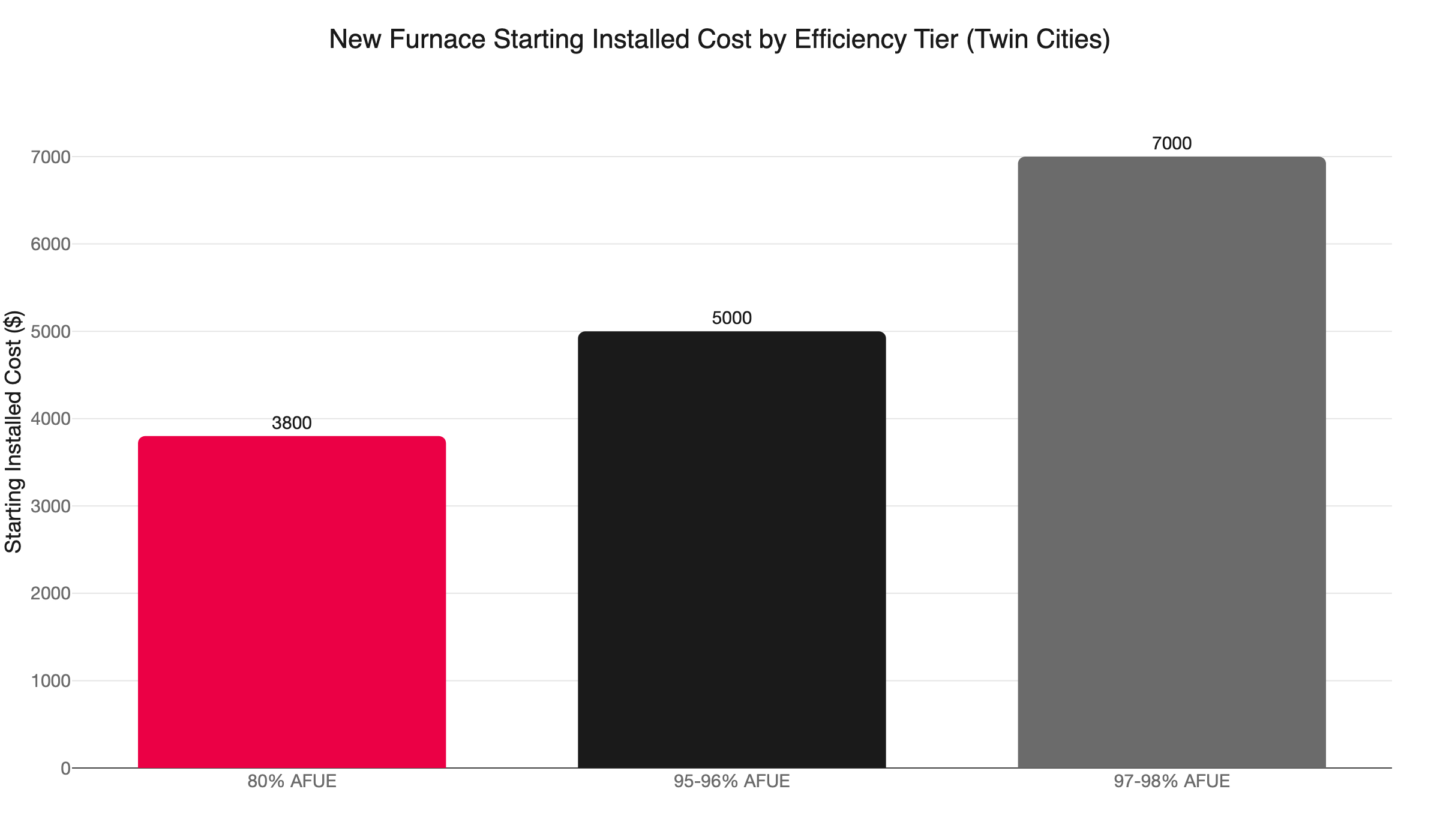
In short: Installed furnace replacement cost in the Twin Cities ranges from $3,800 to $9,500. Most homeowners land in the $5,000-$7,500 range for a mid-tier two-stage condensing furnace. Where your quote falls depends on efficiency tier, brand, and your home’s specific situation.
Here is how installed price ranges break down by efficiency tier:
- 80% AFUE single-stage: $3,800-$5,500 installed
- 95-96% AFUE two-stage: $5,000-$7,500 installed
- 97-98% AFUE variable-speed: $7,000-$9,500 installed
Brand selection also moves the number within each tier. Twin Cities installed cost data shows: Goodman $3,800-$6,000, Carrier $4,500-$8,500, Trane $4,800-$9,000, Lennox $5,000-$9,500. These figures cover equipment and standard labor. They do not include permit costs, ductwork repairs, or venting changes that come with switching efficiency tiers.
The $3,800-$5,500 range for an 80% unit is real on paper. For many Twin Cities homeowners, though, it is not an option. Minnesota’s energy code removes it from consideration for most replacement jobs.
Which Efficiency Tier Makes Sense for a Minnesota Home?
In short: For most Twin Cities replacements, a 95-96% AFUE two-stage furnace is the practical baseline. Minnesota’s energy code eliminates the 80% option in many situations. A 97-98% variable-speed model makes the most sense for larger homes or homeowners planning a long stay.
The 80% problem. Minnesota follows IECC Climate Zone 6A, which has adopted a 90%+ AFUE minimum for replacement furnaces in most municipalities. If your current furnace is 80%, you may not be able to replace it with another 80% unit and still obtain a permit. Before pricing based on the lowest figure, confirm what your city or township allows.
The 95-96% AFUE two-stage sweet spot. This is the most common replacement choice in the Twin Cities. Two-stage operation runs at roughly 65% capacity most of the time, ramping up only on the coldest days. The result is more consistent temperatures throughout the house, quieter operation, and better humidity control in fall and spring. It also qualifies for Xcel Energy and CenterPoint Energy rebates.
Beyond savings, there is a comfort difference. Single-stage furnaces blast heat at full capacity and cycle off, which can feel uneven: too warm when running, cooling off between cycles. Two-stage and variable-speed units run longer at lower output, holding temperatures steadier.
Upgrading from a mid-efficiency unit to a 95-96% AFUE model saves roughly $300-$600 per year on gas bills, with a payback period of four to seven years. Minnesota averages around 8,000 heating degree days per year. That is a long season. Efficiency gains add up.
The 97-98% AFUE variable-speed case. At $7,000-$9,500 installed, variable-speed furnaces cost more upfront. The return comes in near-silent operation, tighter humidity control, and the highest available utility rebates. For homes above 2,500 square feet, or homeowners planning to stay 10 or more years, the math tends to work.
For a deeper look at how AFUE ratings translate to real-world performance in Minnesota winters, see our post on furnace efficiency for Twin Cities homes.
What Drives the Final Quote Up or Down?
In short: Beyond the furnace itself, venting changes, ductwork condition, BTU sizing, and labor are the four biggest variables in any quote. A clean swap with ductwork already in good shape costs far less than a job requiring new PVC exhaust runs and duct sealing.
Venting changes when switching efficiency tiers. Condensing furnaces (96%+) exhaust cool combustion gases through PVC pipe out a sidewall, not up a chimney. If you are upgrading from an 80% furnace that used a metal flue, your installer must run new PVC intake and exhaust lines. That adds $300-$800 for the PVC venting and another $200-$500 to cap or abandon the old flue. Budget an extra $500-$1,300 if your current unit exhausted through the chimney.
Ductwork condition. Leaky or undersized ducts undermine a new furnace before it finishes its first heating season. Sealing runs $500-$1,200; partial duct replacement goes $1,000-$2,500; a full overhaul can reach $3,000-$7,000 in larger homes, according to Minnesota HVAC pricing data. Ductwork problems often show up as symptoms before homeowners identify the source. Rooms that take forever to heat, a thermostat reading correctly but the house not feeling right, or bills that climbed after the furnace was supposedly running fine are all worth mentioning during an assessment. Our post on cold spots and uneven heat distribution covers what is typically driving those complaints.
BTU sizing. Minnesota’s Residential Energy Code requires sizing per ACCA Manual J load calculation. Oversizing cannot exceed 40% of the calculated heating load. General sizing guidelines for the Twin Cities, where the heating design temperature runs at -15°F to -16°F:
- 1,000-1,500 sq ft: 60,000-80,000 BTU
- 1,500-2,500 sq ft: 80,000-100,000 BTU
- 2,500-3,500 sq ft: 100,000-120,000 BTU
An oversized furnace short-cycles: it heats fast, shuts off, and repeats. Short-cycling increases wear, makes humidity harder to control, and often leaves the house unevenly heated.
Labor. A standard furnace replacement takes 12-18 hours. HVAC technicians in Minnesota run $75-$125 per hour. Complex jobs involving venting changes and ductwork repairs extend that total meaningfully.
Does Minnesota Require a Permit for Furnace Replacement?
In short: Yes, always. A mechanical permit is required for every furnace replacement in Minnesota, no exceptions. Budget $150-$450. Your contractor must hold a current DLI mechanical contractor license. Any contractor who suggests skipping the permit is a red flag.
Minneapolis permit costs run $120-$400 specifically. In other Twin Cities suburbs, the $150-$450 range is typical.
The permit triggers a city inspection. That third-party sign-off matters for your homeowner’s insurance and for documentation when you sell. Unpermitted HVAC work can surface as a problem at closing.
Before signing a contract, verify the contractor’s license status at dli.mn.gov. Xcel and CenterPoint rebates also require licensed, permitted work to qualify.
What Rebates Can Twin Cities Homeowners Get in 2026?
In short: Xcel Energy offers $200-$400 for 95%+ AFUE furnaces. CenterPoint Energy offers up to $400 for standard customers and up to $1,200 for income-qualified households. Customers with service from both utilities can stack rebates on qualifying dual-fuel systems for combined savings up to $3,100.
Xcel Energy rebates. Xcel’s natural gas efficiency rebate program:
- $200 at 95% AFUE
- $300 at 96% AFUE
- $400 at 97% AFUE
Submit applications within 180 days of installation. Find the current form at energyrebatecalculator.com/utility/xcel-energy.
CenterPoint Energy rebates. CenterPoint’s heating system program:
- Up to $400 for standard residential customers with a 95%+ AFUE furnace
- Up to $1,200 for income-qualified households (documented but widely underreported)
- $1,100 for a dual-fuel heat pump paired with a 92%+ AFUE backup furnace
Submit CenterPoint rebates by December 31, 2026. Checks arrive from Houston within approximately 10 weeks.
Stacking both utilities. If your home has electric service from Xcel and natural gas from CenterPoint, you may qualify for up to $3,100 in combined rebates on a qualifying dual-fuel system. See Xcel’s program documentation for current details. Few homeowners claim this because few contractors explain it exists.
Quick math example. A 96% AFUE furnace installed at $6,500. Subtract $300 from Xcel and $400 from CenterPoint. Net cost after rebates: $5,800, before financing.
These programs are funded through Minnesota’s Conservation Improvement Program (CIP), a state law requiring all utilities to offer energy efficiency rebates. They are not promotional offers. They are funded by a small surcharge on every customer’s bill. If you are unsure whether you have Xcel service, CenterPoint service, or both, check your utility bills before your installation appointment.
What Happened to the Federal Tax Credit?
In short: It is gone. The One Big Beautiful Bill Act, signed July 4, 2025, eliminated Section 25C effective December 31, 2025. No federal tax credit applies to any furnace installed in 2026. Articles or contractors still citing “up to $600 federal credit” are working from outdated information.
This is the most important correction in this post. Most of the top-ranking articles on furnace replacement cost in Minnesota were written before this change. They still show the credit as an active savings option. It is not.
A few additional facts worth knowing:
- Equipment installed and placed in service by December 31, 2025 may still be claimed on a 2025 tax return using IRS Form 5695.
- Equipment installed in January 2026 or later gets $0 in federal credit, regardless of efficiency rating.
- Under the old Section 25C rules, a gas furnace had to reach 97%+ AFUE to qualify, not just 95%. Most articles citing the credit never clarified this threshold.
Sources: HVAC industry coverage of the credit elimination and a 2026 HVAC tax credit analysis.
The utility rebates from Xcel and CenterPoint are entirely separate from Section 25C. The federal credit ending has no effect on what you can claim from your utility provider.
How Does Financing Change the Monthly Math?
In short: On a $6,000 system, 0% promotional financing over 12-18 months runs $333-$500 per month. Extended financing over 60-120 months drops to $65-$120 per month. Monthly energy savings from a higher-efficiency furnace offset a portion of the payment over the life of the loan.
Here is how the numbers look on a $6,000 installed system, based on financing program data:
| Financing Term | Approximate Monthly Payment |
|---|---|
| 0% promo (12 months) | ~$500/mo |
| 0% promo (18 months) | ~$333/mo |
| Extended (60 months) | ~$120/mo |
| Extended (120 months) | ~$65/mo |
The energy savings piece matters across the life of the loan. Upgrading from a lower-efficiency unit to a 95-96% AFUE furnace saves roughly $25-$50 per month on gas bills during heating season. That does not fully cover a payment. But it reduces the effective out-of-pocket cost over time.
We offer financing on furnace replacements and other larger HVAC jobs, including AC installations. Ask about current terms when you call.
How to Compare Furnace Replacement Quotes
Two quotes on a furnace replacement are rarely comparing the same job. Here is what to verify before signing:
- Equipment efficiency and model. Does the quote specify AFUE rating and stage type (single, two-stage, or variable)?
- Venting work. If you are going from 80% to 96%+, is new PVC venting included or excluded from the price?
- Ductwork. Is an assessment included? If repairs are recommended, are they itemized separately?
- Permit. Is the mechanical permit cost included, or added later?
- Rebate assistance. Will the contractor handle Xcel or CenterPoint rebate paperwork, or does that fall on you?
- Warranty. Written terms for both equipment and labor.
- Load calculation. Is the contractor running a Manual J sizing calculation, or just matching the capacity of the unit being replaced? Matching old-for-old is faster, but it is not always code-compliant and often perpetuates an oversized system.
A quote that looks $800 lower may be missing the permit or skipping a ductwork assessment. Comparing complete written quotes protects you.
Not sure whether it is time to replace rather than repair? Our post on when to replace vs. repair your furnace walks through the decision with a clear framework.
Get an Accurate Furnace Replacement Quote in the Twin Cities
Furnace replacement cost in the Twin Cities varies by thousands of dollars based on efficiency tier, your home’s venting and ductwork condition, and what your municipality requires. A general range is a starting point. Your actual number comes from a technician who has looked at your home.
Northern One Hour is locally owned and operated in Ramsey, MN. We serve Minneapolis, St. Paul, Blaine, Maple Grove, Plymouth, Brooklyn Park, Woodbury, Bloomington, and the surrounding Twin Cities metro. We pull permits, assist with rebate paperwork, and show up when we say we will: “Always On Time… Or You Don’t Pay a Dime!(R)”
Call (763) 260-6662 or schedule a furnace assessment online to get an accurate quote for your home.
Frequently Asked Questions
How much does furnace replacement cost in the Twin Cities? +
Is there a federal tax credit for a new furnace in 2026? +
What rebates are available for furnace replacement in Minnesota? +
Need a technician now?