
Air Purifier vs Air Filter MERV Rating: What Actually Works
Key Takeaways
- MERV measures a filter’s ability to capture particles from 0.3 to 10 microns. Higher is better for air quality, up to the limit your system can handle.
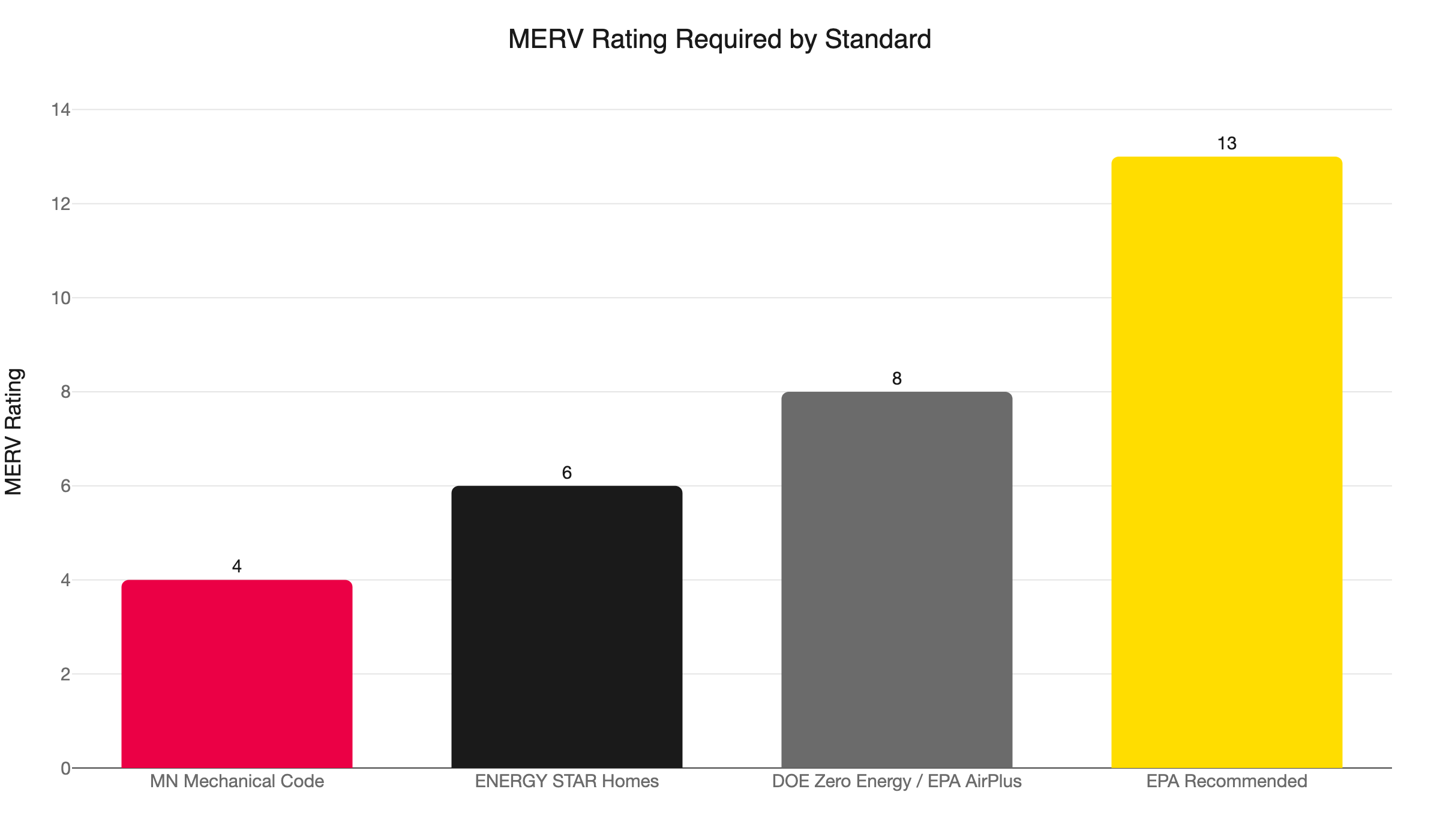
- The EPA recommends MERV 13 as a minimum upgrade target. Minnesota’s mechanical code requires only MERV 4.
- Installing a MERV 13 filter in a system not designed for it can damage your furnace, freeze the AC coil, or burn out the blower motor.
- Your HVAC filter only cleans air when the system is running. A portable air purifier runs independently and covers one room.
- Whole-home air purifiers work inside your ductwork alongside a media filter. They do not replace the filter.
- Ozone generators are not approved by any federal agency for use in occupied spaces.
- ENERGY STAR on a portable air cleaner certifies energy efficiency only, not health performance.
- No Minnesota utility currently offers a rebate for air purifiers or HVAC filters. This is an out-of-pocket cost.
Is Your Air Filter Actually Cleaning Your Air?
Short answer: It depends on the MERV rating you chose and whether your HVAC system can safely handle it. In most homes, the filter only processes air less than 25% of the time. Upgrading the rating helps - but only up to what your equipment can support.
The air purifier vs air filter MERV rating question comes up every time a homeowner walks down the home improvement aisle or sees a wildfire smoke advisory. More numbers, more claims, and the honest answer buried somewhere under the marketing.
EPA guidance shows that HVAC filters only clean air when the system runs - in most homes, less than 25% of the time during heating and cooling seasons. The filter you installed may be doing a fraction of the work you think it is. And a filter rated too high for your system may be quietly stressing your equipment.
This post explains what MERV ratings actually mean, when upgrading helps and when it damages your furnace, how portable and whole-home purifiers fit in, and what Minnesota winters and wildfire smoke seasons add to the equation.
What Is a MERV Rating?
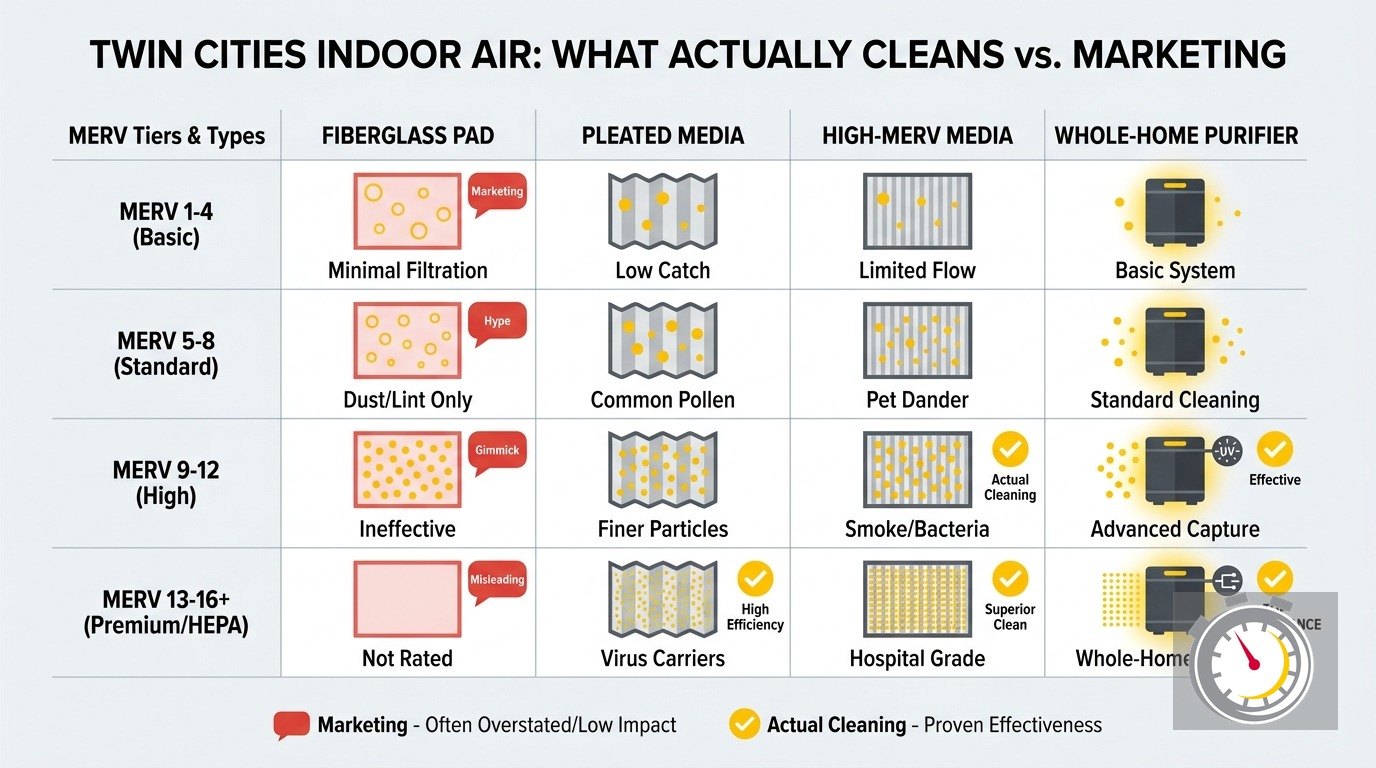
Short answer: MERV stands for Minimum Efficiency Reporting Value. It measures how well a filter captures particles between 0.3 and 10 microns. The scale runs from 1 to 20. Most residential systems use MERV 6 through 13.
MERV is based on ASHRAE standard 52.2 - the national consensus standard for filter testing. When a filter package says “MERV 11,” that rating is reproducible and comparable across manufacturers.
Two competing proprietary systems - FPR (Home Depot’s scale) and MPR (3M/Filtrete’s scale) - are not standardized and are not comparable across brands. If you are evaluating filters from different manufacturers, look for the MERV number.
Higher MERV means finer filtration. A MERV 8 filter captures most pollen, mold spores, and dust mites. A MERV 13 catches fine dust, smoke particles, and bacteria at a rate the EPA considers the minimum for meaningful health benefit. All filters require periodic replacement to function properly.
What Is the Difference Between an Air Filter and an Air Purifier?
Short answer: An HVAC air filter is a physical barrier inside your duct system that traps particles as air passes through. An air purifier processes air through additional technologies: HEPA media, activated carbon, UV-C, or ionization. They serve different purposes and work best together.
The “filter vs. purifier” framing you see in most marketing treats these as competing products. They are not. Your duct filter protects your equipment and handles baseline particle removal. A purifier does supplemental work - often targeting gases, VOCs, or biological contaminants the filter cannot address.
The distinction matters because some purification technologies - ionizers and ozone generators specifically - are marketed as filter replacements. They are not, and some carry real safety risks covered later in this post.
Air Purifier vs Air Filter MERV Rating: Which Actually Cleans Your Air Better?
Short answer: Neither is universally better. Your HVAC filter processes more air per hour than any portable unit but only when the system runs. A portable purifier with a high CADR runs continuously and covers one specific room. For whole-home air quality, the right answer is usually a quality MERV-rated filter plus a portable unit in the rooms that need it most.
Here is how the three options compare:
Your HVAC duct filter
- Filters all air moving through your duct system
- Only runs when heating or cooling is active - less than 25% of the day in most homes
- Captures particles based on its MERV rating
- Does nothing for gases, VOCs, or odors
A portable air purifier
- Covers one room, typically 150-500 square feet depending on the unit’s CADR rating
- Runs independently of your HVAC system - continuous coverage regardless of whether the heat or AC is on
- Look for a high CADR rated for tobacco smoke: that is the smallest particle category tested and the strongest proxy for PM2.5 performance
- Activated carbon models help with gases and VOCs, but only with significant carbon material - thin carbon pre-filters are largely marketing
A whole-home in-duct purifier
- Installed inside your ductwork and works in tandem with your duct filter
- Covers the whole house whenever the system runs
- Adds UV-C, media filtration, or ionization beyond what the duct filter provides
- Does not replace the duct filter
The highest-leverage single move for whole-home particle removal is upgrading your MERV rating - if your system can safely handle it. A portable purifier is the right add-on for bedrooms, nurseries, or rooms where someone has asthma or allergies. Our indoor air quality service covers the whole-home options we install.
Why the Wrong High-MERV Filter Can Damage Your HVAC System
This is the piece most competitor content skips entirely. A denser filter captures finer particles - but it also creates more resistance. Air has to work harder to push through tighter media. In HVAC terms, that resistance is static pressure.
Most residential HVAC systems are designed to operate efficiently at 0.4 to 0.5 inches water column total static pressure. A single filter can consume 0.25 inches of that budget before air even reaches the ductwork. Add an oversized MERV 13 to an older system with undersized ducts, and total system pressure climbs into the damage range.
Here is what breaks first:
- Furnace overheating. Restricted airflow traps heat in the heat exchanger. Safety limits trip. Over time, the heat exchanger can crack - an expensive and potentially dangerous failure.
- Frozen AC coil. Low airflow across the evaporator drops coil temperature below freezing. Ice forms, the system stops cooling, and refrigerant lines can be damaged.
- Burned blower motor. Older PSC (permanent split capacitor) motors lose airflow and simply run longer to reach setpoint. Newer ECM (electronically commutated) motors compensate by working harder - sustained high static pressure can burn them out.
None of this means MERV 13 is bad. It means MERV 13 in the wrong system - or a MERV 13 filter left in too long without replacement - is a liability. The EPA’s own guidance recommends “MERV 13, or as high as your system will accommodate. You may need to consult a professional HVAC technician.” That last sentence is doing a lot of work.
This is exactly where our team can help. We can measure your system’s current static pressure, identify your blower motor type, and confirm the highest MERV rating your equipment can safely run.
What MERV Rating Does Your Twin Cities Home Actually Need?
Short answer: Minnesota’s mechanical code requires only MERV 4 - barely above bare minimum. For meaningful indoor air quality improvement, the EPA recommends at least MERV 13. The right rating for your home depends on your system’s capacity, your household’s health needs, and whether your neighborhood sees wildfire smoke.
Here is the full standards picture, from published sources:
- MERV 4: Minnesota mechanical code minimum (Chapter 1346, adopting the 2018 International Mechanical Code). This rating exists to protect equipment, not occupants.
- MERV 6+: Required for ENERGY STAR certified new homes.
- MERV 8+: Required for DOE Zero Energy Ready Homes and EPA Indoor AirPlus certified homes.
- MERV 13+: EPA’s stated minimum for meaningful health improvement and effective wildfire smoke protection.
The gap between code minimum and EPA recommendation is wide. A MERV 4 filter stops large dust particles. It does very little for mold spores, fine dust, smoke, or bacteria. In a Minnesota home sealed tight against a minus-10-degree January, that gap matters.
If your system cannot safely handle MERV 13, MERV 11 is a reasonable step. If your system is rated for it and you have pets, allergies, asthma, or respiratory concerns in the household, MERV 13 is worth reaching for.
What About Portable Air Purifiers?
Short answer: A portable purifier is a useful tool for targeted room-level filtration. The number that matters is CADR - Clean Air Delivery Rate - specifically rated for tobacco smoke, which is the smallest particle category and the best proxy for PM2.5 performance.
One thing to know before you shop: the ENERGY STAR badge on a portable air cleaner certifies energy efficiency only. The EPA requires that ENERGY STAR-labeled air cleaners carry this disclaimer: “EPA does not endorse any manufacturer claims of healthier indoor air from the use of this product.”
That does not mean portable purifiers do not work. It means the energy badge tells you nothing about air cleaning performance. CADR is the number that does.
For gas-phase pollutants - cooking odors, paint fumes, VOCs from furniture and flooring - look for a unit with an activated carbon filter. But activated carbon only removes gases when there is a significant amount of carbon material. Thin carbon pre-filters on budget units are largely cosmetic.
There is no widely accepted performance standard for gas removal the way CADR covers particles. Buyer awareness is your primary tool here.
We install whole-home air purification systems inside your ductwork - covering the entire house rather than one room, and running every time the system operates.
The Ozone Generator Warning Nobody Puts in the Ad Copy
Search for “air purifier” and ozone generators appear in the results. Some are labeled “ionic air purifiers” or “plasma air cleaners.” They produce ozone, which reacts with airborne contaminants - but the byproducts of those reactions include compounds that are harmful to breathe.
The federal position is not ambiguous. No federal agency has approved ozone generators for use in occupied spaces. The Department of Energy’s Building America Solution Center states that ozone generators are “not safe or effective in removing pollutants” and that ozone mixes with other indoor chemicals to create harmful byproducts.
If you already own one, the standard advice is to run it only in unoccupied spaces and ventilate for several hours before reentry. That advice exists because the device produces a lung irritant.
For homeowners interested in biological air treatment - mold, bacteria, viruses - UV-C systems installed inside the ductwork are a safer alternative. They neutralize biological contaminants without producing ozone as a byproduct.
What Does Minnesota’s Climate Mean for Your Filter Choice?
Short answer: More than most national content acknowledges. Sealed winter homes trap pollutants for months. Summer wildfire smoke now reaches the Twin Cities regularly. Both make MERV 13 protection more important here than in climates with more natural air exchange.
Sealed winter homes. From November through March, Twin Cities homes are as airtight as possible. That is intentional - every dollar of heat escaping through leaks is wasted. The tradeoff is that indoor air recirculates with fewer fresh-air exchanges. Any indoor pollutant source - cooking, pets, off-gassing from furniture and flooring, combustion byproducts from a gas furnace - accumulates through the season. A MERV 13 filter captures more of those particles in every pass through the system. That ongoing accumulation is why upgrading your filter rating matters more in Minnesota than in a climate where windows stay open six months a year.
Our post on what’s really in your air after a Minnesota winter covers the specific pollutant buildup in more detail.
Wildfire smoke. Canadian wildfire smoke has pushed Twin Cities air quality into the unhealthy range in recent summers. During smoke events, the EPA recommends running the highest MERV-rated filter your system can handle, with windows closed. Wildfire smoke carries fine PM2.5 particles - the category MERV 8 handles inconsistently and MERV 13 captures at a rate the EPA considers meaningful.
One thing worth knowing before you budget: no Minnesota utility currently offers a rebate for filters or air purifiers. Xcel Energy’s residential rebate program covers cold-climate heat pumps, high-efficiency gas furnaces, central AC, and smart thermostats - not IAQ accessories. Filter upgrades are out-of-pocket math, which makes it worth understanding what the numbers actually mean before you buy.
How Do You Know What Your System Can Handle?
Short answer: For a MERV 13 upgrade, a professional static pressure measurement is the safest starting point. A technician can check your system’s current pressure, identify your blower motor type, and confirm the highest MERV rating your equipment can safely run.
Here is what you can assess on your own before calling:
- Filter slot size. A 1-inch filter slot is rarely compatible with MERV 13. Thicker housings - 4 or 5 inches - handle higher ratings better because the larger media surface area reduces pressure drop for the same filtration level.
- Current filter rating. If you are running MERV 6 or lower and the system has run well for years, MERV 8 is almost always a safe step up without a professional assessment first.
- Replacement frequency. A MERV 13 filter in a pet-heavy home sealed for a Minnesota winter may need replacement every 60-90 days rather than the standard 90-day interval. A clogged MERV 13 creates more pressure drop than a fresh MERV 8.
- Whole-home purifier as an alternative. If your ductwork or equipment genuinely cannot support MERV 13, an in-duct air purifier can add filtration capacity without requiring a denser filter media.
Diagnosing filter-related stress on your furnace or AC is part of every service call our team makes. Our post on hidden HVAC problems winter may have left behind covers several signs that a filter issue has already started affecting your equipment.
Ready to Get Your Air Quality Right?
We are Northern One Hour Heating and Air Conditioning - locally owned and operated in Ramsey, MN, serving Minneapolis, St. Paul, Blaine, Maple Grove, Plymouth, Brooklyn Park, Woodbury, Bloomington, and the surrounding Twin Cities metro.
If you are unsure what MERV rating your system can handle, or if you have noticed reduced airflow, more frequent system cycling, or higher energy bills after swapping to a denser filter, those are signals worth investigating before they become a repair bill.
Our promise is simple: “Always On Time… Or You Don’t Pay a Dime!(R)” We back every visit with transparent pricing and a 100% satisfaction guarantee.
Call (763) 260-6662 or book online to schedule an indoor air quality assessment, a filter sizing consultation, or a whole-home air purification installation.
Frequently Asked Questions
Can I safely use a MERV 13 filter in any furnace? +
Do I need both an air filter and an air purifier? +
What MERV rating protects against wildfire smoke? +
Is the ENERGY STAR badge on a portable air purifier a health rating? +
Need a technician now?